Come to an Info Session on Wednesday 2nd September or Monday 14th September
SPACE (Social Prescribing and Civic Engagement) aims to bring together social prescribing and volunteering to create an environment and approach that supports the health and well-being of people with health and rehabilitation needs.
The project addresses education and training needs of health, social care and rehabilitation professionals, NGO/Civil Society leaders, as well as policy makers, and as such making a direct impact on the EU Cancer Mission contributing to the National Cancer Plans.
The main goal of the project is to work transnationally and across sectors to promote dialogue, knowledge exchange and common understanding of Social Prescribing. We will:
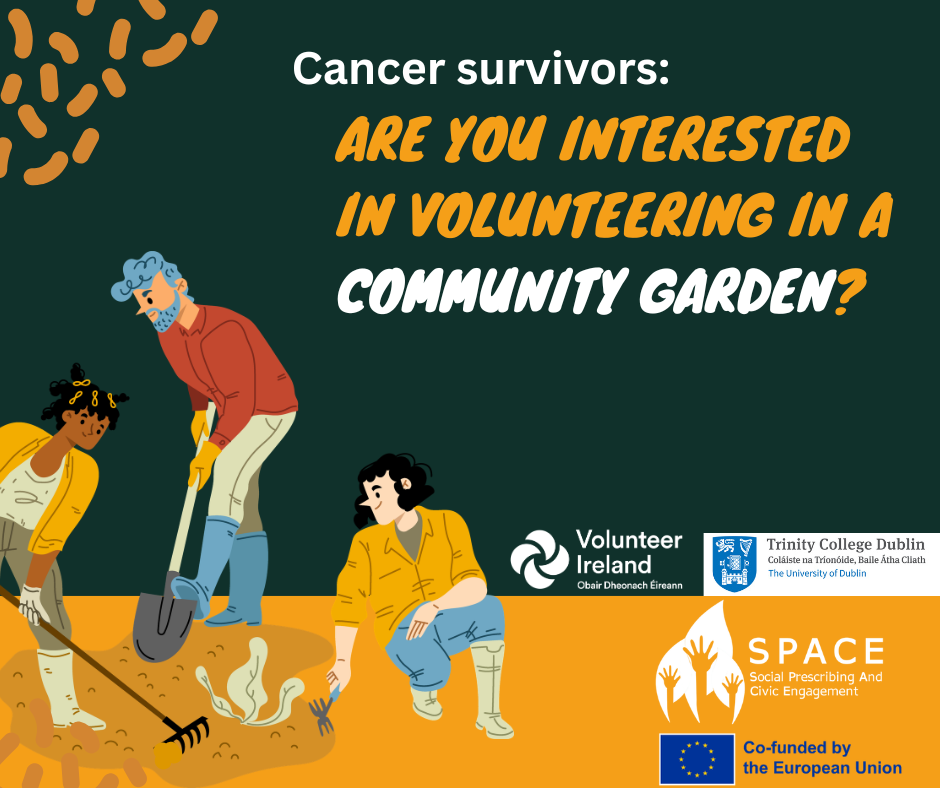
We are recruiting participants to take part in a research study that is being carried out by Trinity College Dublin and Volunteer Ireland. We will be studying people post cancer treatment volunteering in community gardens and the impact of this on their health and wellbeing.
If you are interested and wish to take part, please take time to read below carefully and discuss it with your family, friends or GP if you wish.
If there is anything which is not clear, or if you would like more information, please contact us at [email protected].
We are interested in understanding the effects of participating in volunteering in community gardens for adults who are post-cancer treatment. You are being invited to participate if you are at least six months post-cancer treatment and you have an interest in volunteering in a community garden. We are hoping to have twenty-five (25) volunteers take part in the study between April and November 2026.
A substantial body of research has demonstrated the value of participating in volunteering activities in community gardens. It can support the physical, mental and social health and wellbeing of people who are post-cancer treatment. The SPACE programme is a new programme which is being tested in Ireland, Spain, the UK, Malta, and Greece. It is examining volunteering in community gardens as a way to promote recovery and wellbeing for people who have had treatment for cancer.
If you would like to take part, send us an email to [email protected] and we will contact you, make sure that this is the right project for you (that you are eligible), and discuss our information leaflet and consent form with you. After receiving your completed consent form, we will then complete some questionnaires with you. This can be done over the phone, over email, or in-person (whatever suits you best).
We will then arrange to connect you to a local community garden. We will accompany you to your first session at the community garden and introduce you to the staff and other volunteers. You will be asked to attend this community garden once a week for one hour each time, but you can attend more if you wish. The minimum expected attendance is once every two weeks.
You can stop taking part at any stage, if you don’t want to continue.
Volunteering in a community garden can involve horticultural, creative, wellbeing, and community activities. Some examples of these activities include:
| Type of activity | Example |
| Horticultural | Sowing, planting, pruning, composting, seed harvesting, harvesting crops or other physical activities. |
| Creative | Helping with simple garden design tasks, nature art, and/or photography to capture activities in the garden and visually celebrate achievements. |
| Wellbeing | Gentle stretching, mindful walks, breathing exercises. |
| Community | Helping with preparing for shared tea breaks, harvest events, or preparing produce-sharing tables. |
| Learning | Reflective journaling or storytelling. |
You will discuss your preferred activities with the community garden leaders to ensure both your needs and the garden’s needs are fulfilled.
We will contact you one week after your first session in the community garden to check in with you. We will also check in with you four and twelve weeks after you start to attend the garden. These check-ins will be about your wellbeing and engagement in the community garden.
Additionally, you will be asked to complete the two more study questionnaires (measuring quality of life and social support) at two additional timepoints.
Your participation will contribute to improving the experience of people who have undergone treatment for cancer.
Safety while volunteering in a community garden:
Safety is a central and continuous responsibility within the SPACE programme, not an afterthought. It is integrated into everyday practice and supported by clear procedures to protect both people who are post-cancer treatment and staff/volunteers in community gardens. A safety checklist will be completed by community garden leaders to ensure that each session is conducted safely and consistently. The community garden staff will have received training from the SPACE programme team on how to adapt gardening activities for people post-cancer treatment.
Data Breach:
We take many measures to ensure the confidentiality of all data and the risk to you of a breach of confidentiality is considered very low.
At any point in the programme, you may stop participating for any reason.
The results of the study will be published in a report with the other European partners and may also be reported in scientific journals and conferences. No information which reveals your identity will be disclosed. Some quotations from the questionnaire may be used in reports, but nothing that would include your identity.
If you decide to apply to participate, we will talk you through how we use information and how data is protected throughout the project. Your privacy is important to us. We take many steps to make sure that we protect your confidentiality.
This study has been approved by Trinity College Dublin, Faculty of Health Sciences Ethics Committee. Approval was granted on 06/03/2026.
This study is being completed as part of a collaboration between Trinity College Dublin, the Centre European Volunteering, Volunteering Ireland (trading as Volunteer Ireland), and national volunteer organisations in Spain, the UK, Malta, and Greece. Funding for this collaboration is being provided by the European Union under the ERASMUS-EDU-2024-PCOOP-ENGO programme.
No, we are not paying you to take part in the study.
Contact [email protected] for further information
The research studies people after cancer treatment volunteering in community gardens and the impact of this on their health and wellbeing. This means we will have the same written questionnaire about your well-being in the beginning of the programme, after a couple of months and at the end of the programme. The results of this questionnaire is handled confidentially and we will use fake names if we write about anyone involved.
No. You will not be expected or pressured to talk about your cancer journey at the garden. The study is a confidential process, and you share as much about yourself with fellow volunteers as you feel comfortable with. Your data will be recorded by the study team and not the gardens, and it will be anonymous in the study, so your name or other details will not be traceable in the study report. Health information is asked by the study team to confirm you are eligible, to describe the study population, and to describe the wellbeing outcomes in relation to participants’ cancer recovery stage. Only minimal, relevant data is asked and it will always be in a confidential environment.
Absolutely! Community gardens would love to have more volunteers involved!
We ask you to come to the garden once a week for an hour, but at a minimum once every other week for 2 hours. If you have to skip a week here or there, that is not a big issue, just make sure that you let the garden know so they know not to expect you.
You can stop volunteering and your participation in the study at any time. You can also stop participating in the study, but keep volunteering. And if you want to keep volunteering with the garden after the study, you can do that too. If you wish stop, please let us know. We will not try to talk you back into it and will respect your decision.
The project is led by the Centre European Volunteering (Belgium), and is implemented together with seven other organisations:
-European Platform for Rehabilitation (Belgium)
-Volunteer Ireland (Ireland)
-World Organization of Family Doctors (Belgium)
-Heaton Mersey Village Conservation Group (United Kingdom)
-Hellenic Cancer Federation (Greece)
-Malta Council for the Voluntary Sector (Malta)
-Fundacio Institut Universitari per a la Recerca a L’atencio Primaria de Salut Jordi Gol I Gurina (Spain)
This Erasmus Plus project is co-funded by the European Union.